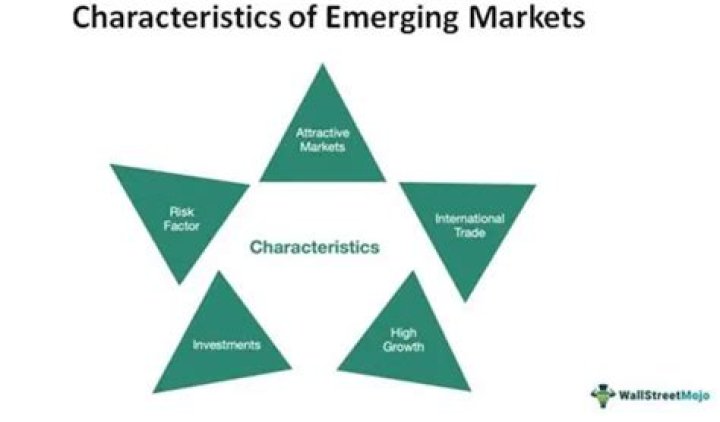
Characteristics of emerging economies

Lily Fisher
Published Feb 15, 2026
What are the characteristics of a developed market?
In investing, a developed market is a country that is most developed in terms of its economy and capital markets. The country must be high income, but this also includes openness to foreign ownership, ease of capital movement, and efficiency of market institutions.How do you identify emerging markets?
One of the simplest ways to determine whether a market is emerging is to see whether it appears in a financial index that tracks emerging markets, such as the MSCI Emerging Markets Index or the MSCI Frontier Markets Index.What are considered emerging markets?
Also known as “developing” markets, emerging markets tend to be countries whose economies are experiencing rapid economic and household income growth and industrialization. They differ from their “developed” market counterparts in four main ways. They have: Low household incomes.Which of the following is not a characteristic of emerging industry?
Low per capita incomes but rapid pace of economic development. High income equalities. High rates of emigration to the developed world.What are the characteristics of emerging?
Characteristics of Emerging Markets- Market volatility.
- Growth and investment potential.
- High rates of economic growth.
- Income per capita.
Why are emerging economies important?
Emerging market economies typically feature a unified currency, stock market, and backing system, and are in the process of industrializing. Emerging market economies can offer greater returns to investors due to rapid growth, but also offer greater exposure to some inherent risks due to their status.What are emerging and developing countries?
Emerging markets, also known as emerging economies or developing countries, are nations that are investing in more productive capacity. 1 They are moving away from their traditional economies that have relied on agriculture and the export of raw materials.What is the difference between developing and emerging economies?
Developing countries are the countries that have not seen any significant growth in their economy due to sticking to traditional growth practices such as agriculture. Emerging markets are the countries that have witnessed massive economic growth due to the development of industrial and technological sectors.How does emerging economies affect business?
Emerging economies as a threat for businessDoing business in emerging economies is not straightforward. An increased risk of intellectual property theft, restrictions on the methods of doing business and competitive challenges from established domestic businesses are threats that need to be overcome.
What are the largest emerging economies?
There are many emerging markets around the world, but the four largest are known as the BRICs (an acronym for Brazil, Russia, India, and China). Many investors believe that these markets are relatively stable and may eventually replace the G7 as the world’s next superpowers.What are developed economies in business?
Countries with relatively high levels of economic growth and security are considered to have developed economies. Common criteria for evaluation include income per capita or per capita gross domestic product.Why are emerging markets riskier?
The prices of shares and units and income there from can go down as well as up, and you may not get back the full amount invested. Past performance is no guarantee of future performance. Currency fluctuations will affect the value of overseas investment. Emerging Markets can be more risky than developed markets.Are Emerging Markets riskier?
Because emerging markets are viewed as being riskier, they have to issue bonds that pay higher interest rates. The increased debt burden further increases borrowing costs and strengthens the potential for bankruptcy. Still, this asset class has left much of its unstable past behind.What are the dangers of targeting emerging markets?
Risks of investing in emerging markets- Political risk. Emerging markets may have unstable, even volatile, governments.
- Economic risk. These markets may often suffer from insufficient labor and raw materials, high inflation or deflation, unregulated markets and unsound monetary policies.
- Currency risk.
Are emerging markets a good investment?
As Lazard put the matter: “When yields are gradually rising due to a strong recovery in economic growth, emerging markets can outperform, particularly the economically sensitive, traditional value securities, such as materials, energy, and financials.” Net-net, the picture looks good.Are emerging economies making a comeback?
Key Takeaways. Emerging market (EM) economies are recovering from a deep decline in activity. We forecast average GDP in EMs, excluding China, to decline 6.4% in 2020 and grow 6.2% in 2021.How much of your portfolio is emerging markets?
Estimates of emerging market holdings in US portfolios range from 3% to 7%.What are the top emerging markets?
Economy| Rank | Country | Peak Year |
|---|---|---|
| 1 | China | 2021 |
| 2 | India | 2021 |
| 3 | Russia | 2021 |
| 4 | Indonesia | 2021 |