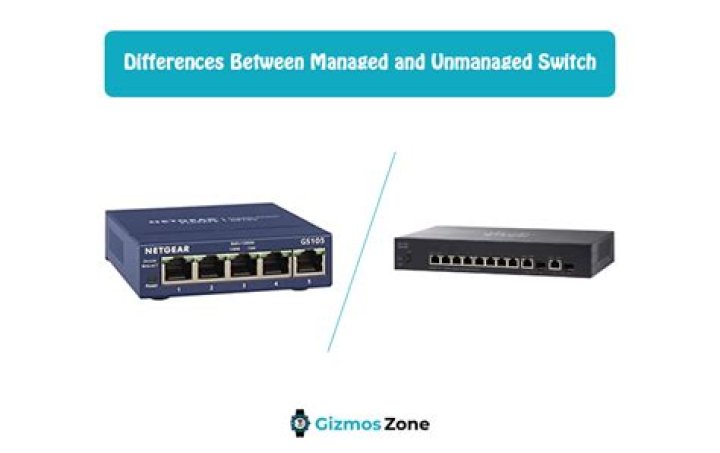
Difference between managed and unmanaged switch

Samuel Coleman
Published Feb 12, 2026
Do I need a managed or unmanaged switch?
On a basic level, an unmanaged switch allows you to immediately plug-and-play devices into your network, while a managed switch allows for greater control over it. However, the differences go deeper, so it’s time to look at the features, performance, security, cost, and application of each.What is the difference between managed switch and unmanaged switch?
A Managed Switch allows LAN traffic to be controlled and prioritized through configuration changes whereas an unmanaged switch is manufactured with a standard configuration that cannot be changed.What is the advantage of a managed switch?
A managed switch enables the creation of Access Control Lists (ACLs), which can control the specific network traffic of users by using simple “allow” and “deny” statements. In addition, managed switches let you view the MAC address table to see what devices and users have accessed your device.Do you need a managed switch?
It is important to emphasize that most homes do not need a managed switch. However, if you have a smart home (one with multiple IoT devices) and want to integrate and control them, a managed switch may be the right choice for you.Can a managed switch act as a router?
Function: Managed switch can connect multiple devices and manage ports and VLAN settings. However, router just directs data in a network and passes them between computers or between computers and the modem. Address used for data transmission: A managed switch uses Mac address while a router uses IP address.Can I use a managed switch as unmanaged?
It is possible to run a managed switch and use it out of the box just like an unmanaged switch. By operating the managed switch in “Open Mode”, having no configuration set up, means the device will be set up to the default VLAN where all ports are members of the default VLAN.Do I need a managed switch for VLAN?
You would go with a managed switch if you are going to have multiple subnets/VLANs or need to configure/manage specific ports etc. This is assuming there is some other device in place that will be handling the routing such as a firewall, or basic router etc.Can a managed switch assign IP addresses?
But since the switch does not have the capability to assign IP addresses, the computers connected to it will not be able to communicate with each other. They will get an Automatic Private IP Address (APIPA). You need to assign a static IP address to your computers.Do unmanaged switches have an IP address?
Unmanaged and layer 2 network switches do not have an IP address, whereas managed switches and layer 3 switches do. A network switch with an IP address is required for Telnet which allows remote access to the switch. The IP address of a switch can be found via the router or an IP scanner.Do unmanaged switches have DHCP?
Unmanaged switches never include DHCP servers, as there would be no way to disable it and you can’t have more than one DHCP server on a network. You’ll need to either set up static addresses, or connect a device with a DHCP server (your NAS likely has the option to enable one).How do I find unmanaged network switches?
1 Answer. Unmanaged switches have no IP address, but you could start by looking at the MAC tables on your managed switches and find inconsistencies. A managed switch will learn the MAC of the device attached to it. Find the MAC that doesn’t belong to a known IP, that’s probably the MAC on the unmanaged switch.Can we assign IP address to layer 2 switch?
ip address cannot be configured on layer2 switch ports. It’s feasible to configure ip address for accessing switch with management IP address VLAN can be created and assign ip address to Vlan . There is not such thing as IP on layer 2 device.Why does a Layer 2 switch need an IP address?
2 Answers. An IP address on a true layer 2 only switch is used for management (accessing the CLI remotely, sending SNMP traps, logging, TACACS/RADIUS, etc.). The IP address on the switch is in no way required for the switch to actually do its job, which is to switch frames.What is the difference between a Layer 2 switch and a layer 3 switch?
A Layer 2 switch only works with MAC addresses and doesn’t interact with any higher layer addresses, such as an IP. A Layer 3 switch, on the other hand, can also do static routing and dynamic routing, which includes IP and virtual local area network (VLAN) communications.What is the purpose of assigning an IP address to a switch?
What is the purpose of assigning an IP address to a switch? Explanation: Switch is a layer 2 device and doesn’t use network layer for packet forwarding. The IP address may be used only for administrative purposes such as Telnet access or for network management purposes.Does VLAN need IP address?
VLANs do not really have IP addresses assigned to them. They have a network assigned to them, or a subnet, or a network range, however you want to refer to it. The address the OP supplied us is an assignable address within the range of 192.168. 4.1-255.How does a switch prevent loops?
How does STP prevent loops? Because the “best ports” are put into forwarding state and the other ports are put into blocking state, there are no loops in the network. When a new switch is introduced to the network, the algorithm and port states are recalculated to prevent a new loop.How do I configure a switch?
How to configure Cisco switch?- Initial command prompt “Switch>” appears on the screen.
- Type “enable” next to it and press “Enter”.
- This will take you into the “EXEC” mode, also known as the Global Configuration mode.
- Go into configure mode using configure terminal.
- Enter the configuration commands one per line.
How do you use a console as a switch?
Step 1 Locate the console port on the back of the Router/Switch. Step 2 Connect the console (or rollover) cable to the console port on the Router/Switch. Step 3 Use the correct adapter to connect the other end of the cable to your terminal or PC.How do I putty into a switch?
Configure putty to be able to communicate with the router over the USB port ( /dev/ttyUSB0 ).- run sudo putty.
- Click on Serial for the Connection Type:
- Set the serial line to /dev/ttyUSB0.
- Click on Keyboard, then set backspace key to Control-H.
- Click on Session . Click on Default Settings. Click Save .
- Click Open .
What are the steps to configure a switch for SSH?
Once you enable SSH, you can access it remotely using PuTTY or any other SSH client.- Setup Management IP. First, make sure you have performed basic network configurations on your switch.
- Set hostname and domain-name.
- Generate the RSA Keys.
- Setup the Line VTY configurations.
- Create the username password.
- Verify SSH access.