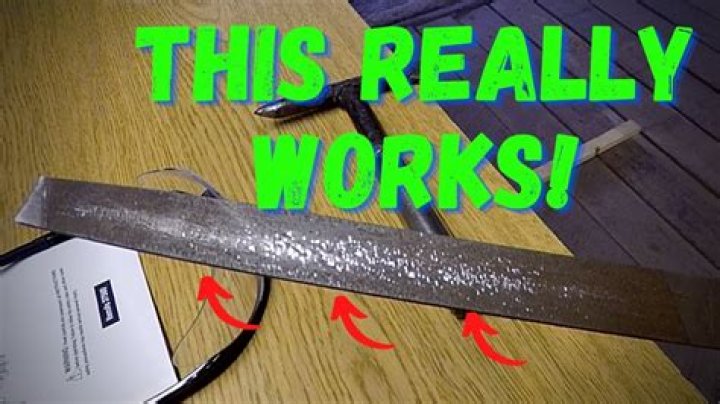
How to clean a metal file

Mia Horton
Published Mar 01, 2026
How do you clean metal files?
How do you clean and sharpen metal files?
How do I restore a metal file?
What tool is used to clean the teeth of a file?
Clean your teethA file card is a must-have accessory. Use the nylon bristle side to clean rasps and the wire bristle side to clean files. You can use a metal pick or finishing nail to clean stubborn debris from file teeth, but any metal–even brass bristles–will eventually dull your rasp’s teeth.
What is the best way to clean a file?
Using a File Card Brush to Clean a File- All you need to do is place the file card onto the file bristle side down, then push it sideways along the file in the direction of the teeth.
- This will then push any debris along the grooves between the teeth. This should then fall out of the file once it reaches the end.
What are the 3 types of files?
Stores data (text, binary, and executable).What are the 2 types of files?
There are two types of files. There are Program files and Data Files.Which are the basic types of files?
6 Different Types of Files and How to Use Them- JPEG (Joint Photographic Experts Group)
- PNG (Portable Network Graphics)
- GIF (Graphics Interchange Format)
- PDF (Portable Document Format)
- SVG (Scalable Vector Graphics)
- MP4 (Moving Picture Experts Group)
What are the four types of files?
The four common types of files are document, worksheet, database and presentation files.What data type is a file?
A FILE is a type of structure typedef as FILE. It is considered as opaque data type as its implementation is hidden. We don’t know what constitutes the type, we only use pointer to the type and library knows the internal of the type and can use the data.What is file and example?
A collection of data or information that has a name, called the filename. Almost all information stored in a computer must be in a file. There are many different types of files: data files, text files , program files, directory files, and so on. For example, program files store programs, whereas text files store text.What is called file?
A file is a container in a computer system for storing information. There are different types of files such as text files, data files, directory files, binary and graphic files, and these different types of files store different types of information.What is difference between file and folder?
A file is the common storage unit in a computer, and all programs and data are “written” into a file and “read” from a file. A folder holds one or more files, and a folder can be empty until it is filled. A folder can also contain other folders, and there can be many levels of folders within folders.What are the six basic file types?
Six basic file operations. The OS can provide system calls to create, write, read, reposition, delete, and truncate files.system call before that file can be used.
- The.
- This call can also accept access-mode information (create, read-only, read-write, append-only, and so on).
- The.