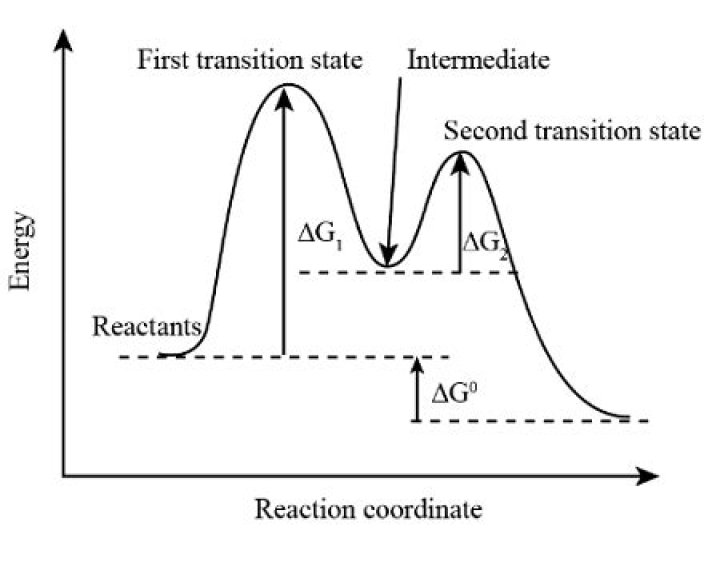
DGo (a delta G, with a superscript o), is the free energy change for a reaction, with everything in the standard states (gases at 1 bar, and solutions at 1 M concentration), and at a specific temperature (usually 25°C) DG (just delta G). This is the free energy change for a reaction that is not at the standard state.
What does Hammond’s postulate state?
Hammond’s postulate states that the transition state of a reaction resembles either the reactants or the products, to whichever it is closer in energy. In an exothermic reaction, the transition state is closer to the reactants than to the products in energy (Fig.
What is required for Hammond’s postulate to be valid?
The official version of Hammond’s postulate is this: If two states, for example, a transition state and an unstable intermediate, occur consecutively during a reaction process and have nearly the same energy content, their interconversion will involve only a small reorganization of the molecular structures.
What is Gibbs energy class 11?
Gibbs Energy is the maximum (or reversible) work that a thermodynamic system can perform at a constant temperature and pressure. The reversible work in thermodynamics implies a special method in which work is carried out such that the system remains in perfect equilibrium with all its surroundings.
What does ∆ s mean?
change in entropy
∆S is the change in entropy (disorder) from reactants to products. R is the gas constant (always positive) T is the absolute temperature (Kelvin, always positive) What it means: If ∆H is negative, this means that the reaction gives off heat from reactants to products.
Which carbocation is most stable?
tertiary carbocation
The carbocation bonded to three alkanes (tertiary carbocation) is the most stable, and thus the correct answer. Secondary carbocations will require more energy than tertiary, and primary carbocations will require the most energy.
What is the importance of Hammond’s postulate in halogenation of alkanes?
The Hammond postulate (see also Early and late transition states) explains the high selectivity of bromination. According to this postulate, the structure of the transition state of endothermic bromination resembles the product. That is, the intermediately formed alkyl radical.
What does the Hammond postulate tell us about an endergonic reaction step?
The Hammond postulate would theorize that the distance between A and B in the transition state would be relatively large thus resembling the reactants where A and B are two isolated species. For an endergonic reaction, the transition state is closer in energy to the product.
Why are 3 carbocation is most stable?
Tertiary carbocations are more stable than primary or secondary carbocations because they have three methyl groups to distribute it’s positive charge rather than only one or two methyl groups. … Of course, the more the positive charge is spread out, the more stable your carbocation will be!
Are Benzylic Carbocations stable?
Benzylic carbocations are so stable because they have not one, not two, but a total of 4 resonance structures. This shares the burden of charge over 4 different atoms, making it the MOST stable carbocation.
How do I know if my carbocation is stable?
The three factors that determine carbocation stability are adjacent (1) multiple bonds; (2) lone pairs; and (3) carbon atoms. An adjacent π bond allows the positive charge to be delocalized by resonance. Thus, H2C=CHCH+2 is more stable than CH3CH2CH+2 .
Is 1 degree carbocation more stable?
and more the number of electron providing group more stable will be carbocation. therefore 3 degree carbocation is more stable. Tertiary carbocation possess minimum positive charge due to – (1) hyper conjugation (2) electron releasing inductive effect of alkyl group .
What is benzyl carbocation?
A benzylic carbocation is a resonance-stabilized carbocation in each of the two equally stable major resonance forms of which the formal charge of +1 is on a benzylic carbon.eg: The lightest benzylic carbocation 1 is called the benzyl carbocation.
How do you identify a 3 degree carbocation?
In a tertiary (3°) carbocation, the positive carbon atom is attached to three alkyl groups, which may be any combination of same or different. A tertiary carbocation has the general formula shown in the box. R, R’ and R” are alkyl groups and may be the same or different.
Why is the degree 3?
and more the number of electron providing group more stable will be carbocation. therefore 3 degree carbocation is more stable. Tertiary carbocation possess minimum positive charge due to – (1) hyper conjugation (2) electron releasing inductive effect of alkyl group . Lesser is the charge higher is stability.
Why is benzyl Carbocation stable?
The stability of the carbocations increases from primary carbocation to tertiary carbocation as the methyl group increases. … But out of all these carbocation the benzyl carbocation is considered to be most stable because of the delocalization of charge over the ring due to resonance of $$pi electrons$$.
What is alkyl group?
Definition: An alkyl is a functional group of an organic chemical that contains only carbon and hydrogen atoms, which are arranged in a chain. Examples include methyl CH3 (derived from methane) and butyl C2H5 (derived from butane).