T
The Daily Insight

What is the definition of opportunity cost

Author

Emily Cortez

Published Feb 27, 2026

What is the best definition of opportunity cost?

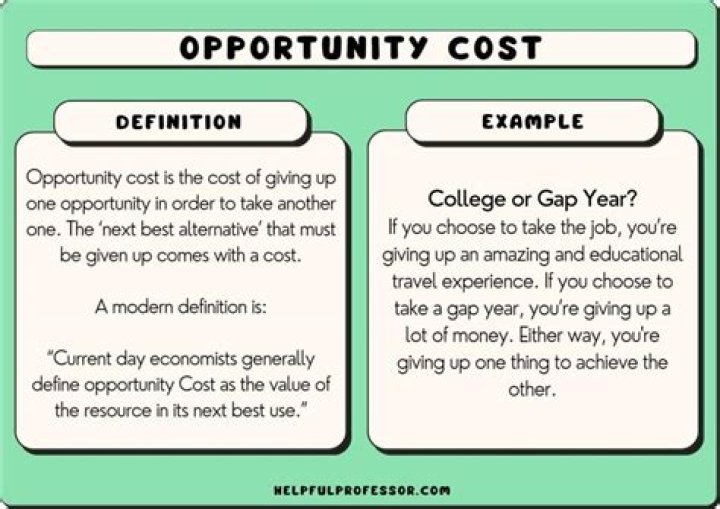
Opportunity costs represent the potential benefits an individual, investor, or business misses out on when choosing one alternative over another.

What is the definition of opportunity cost in economics?

“Opportunity cost is the value of the next-best alternative when a decision is made; it’s what is given up,” explains Andrea Caceres-Santamaria, senior economic education specialist at the St. Louis Fed, in a recent Page One Economics: Money and Missed Opportunities.

What are opportunity costs examples?

Examples of Opportunity Cost. Someone gives up going to see a movie to study for a test in order to get a good grade. The opportunity cost is the cost of the movie and the enjoyment of seeing it. At the ice cream parlor, you have to choose between rocky road and strawberry.

What is an example of opportunity cost in business?

Small businesses factor in opportunity costs when computing their operating expenses in order to provide a bid or estimate on the price of a job. For example, a landscaping firm may be bidding on two jobs each of which will use half of its equipment during a particular period of time.

What is opportunity cost in economics class 12?

An opportunity cost is the cost of an alternative that must be forgone in order to pursue a certain action. In other words, the cost of enjoying more of one good in terms of sacrificing the benefit of another good is termed as opportunity cost of the additional unit of the good.

What is opportunity cost in economics class 11?

What is Opportunity Cost in Economics ? Opportunity Costs are the benefits that an individual, investor or business forego (miss out) , when they choose one alternative over another. Opportunity Cost is the next best alternative, which is foregone, when a particular alternative is chosen.

How do you calculate opportunity cost examples?

How to Calculate Opportunity Cost
  1. Opportunity Cost = Return on Most Profitable Investment Choice – Return on Investment Chosen to Pursue.
  2. Opportunity Cost = $80,000 (selling ten cars worth $8,000 each) – $60,000 (selling 5 trucks worth $12,000 each)
  3. Opportunity Cost = $20,000.

What is another word for opportunity cost?

Hypernym for Opportunity cost:

cost of capital, carrying cost, capital cost, carrying charge.

What is opportunity cost in economics Slideshare?

Opportunity cost is the cost of a decision in terms of the best alternative given up in order to achieve it. It is the best alternative forgone.

What is opportunity cost in economics Upsc?

Opportunity cost is a concept in Economics that is defined as those values or benefits that are lost by a business, business owners or organisations when they choose one option or an alternative option over another option, in the course of making business decisions.

What is opportunity cost and marginal opportunity cost?

Opportunity cost is an economic or financial concept that expresses the relationship between scarcity and choice while marginal cost is an economic or financial concept that represents the cost of producing an additional unit.

Why is opportunity cost studied in economics?

As a representation of the relationship between scarcity and choice, the objective of opportunity cost is to ensure efficient use of scarce resources. It incorporates all associated costs of a decision, both explicit and implicit.

What is opportunity cost principle in managerial economics?

In Managerial Economics, the opportunity cost concept is useful in decision involving a choice between different alternative courses of action. Resources are scarce, we cannot produce all the commodities. For the production of one commodity, we have to forego the production of another commodity.

What is marginal opportunity cost?

There are three steps to determining a marginal opportunity cost: … If you know your current costs for producing a product, the first step is determining how much it will cost to produce additional quantities of that product. In this doughnut shop example, you know how much it currently costs to make doughnuts now.

What is the difference between economic cost and opportunity cost?

Economic costs include accounting costs, but they also include opportunity costs. Opportunity costs are the benefits you could have received if you had chosen one course of action, but that you didn’t because you went with another option. An example is probably helpful here.

What does the opportunity cost means explain with a numerical example?

Opportunity cost is the next best alternative foregone in choosing the best one. Suppose an economy produces only two goods X and Y. … if the economy decides to produce 2X, it has to cut down production of Y by 2 units because resources are limited. in this case opportunity cost of producing one more unit of X is 2Y.

What is the formula of marginal opportunity cost?

It is calculated by taking the total change in the cost of producing more goods and dividing that by the change in the number of goods produced.

How do you calculate opportunity cost in marginal costing?

You can calculate this cost by multiplying the interest rate or rate of return you would otherwise have received on the capital. If interest rates are 5 percent, then you have given up the opportunity to earn $25,000 with that $100,000 over the next year.