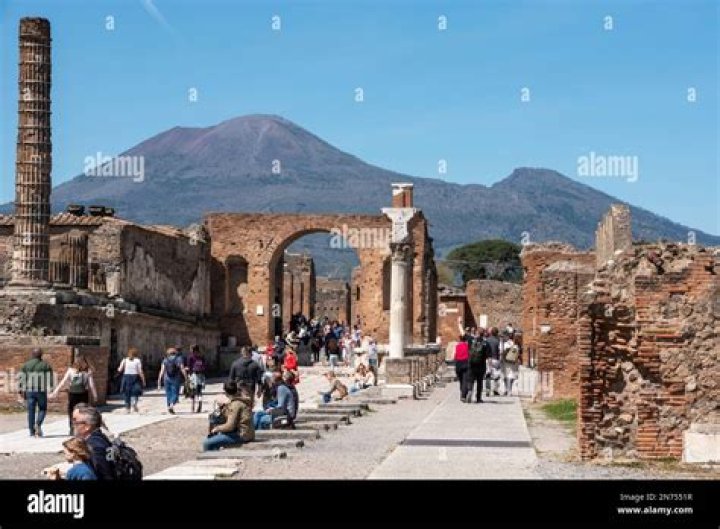
What was pompeii famous for

Emily Cortez
Published Feb 13, 2026
Why was Pompeii popular among Romans?
The city of Pompeii was a popular vacation destination for the Romans. … It was here that much of the business of the city was carried out. There were also temples to Venus, Jupiter, and Apollo near the forum. An aqueduct carried water into the city to be used in the public baths and fountains.What was Pompeii famous for before the eruption?
Pompeii Had A Network of One-Way StreetsProfessor Eric Poehler from the University of Massachusetts has spent years studying the narrow streets of Pompeii. Before the eruption of Vesuvius, it was a bustling city of 12,000 people that had a complex water system, an amphitheatre, gymnasium, a port and about 100 streets.
Did anyone from Pompeii survive?
That’s because between 15,000 and 20,000 people lived in Pompeii and Herculaneum, and the majority of them survived Vesuvius’ catastrophic eruption. One of the survivors, a man named Cornelius Fuscus later died in what the Romans called Asia (what is now Romania) on a military campaign.What killed the people of Pompeii?
A giant cloud of ash and gases released by Vesuvius in 79 AD took about 15 minutes to eliminate the inhabitants of Pompeii, research suggests.Are the Pompeii bodies real?
There are no bodies but there are plaster casts of bodies. Plaster was pumped into the space left behind in the hardened ash after the the biological material decomposed. It was thought that the facial expressions revealed in the plaster were the victims’ gasps for air.Was there any warning before Pompeii?
there were warnings of the eruption of Vesuvius. Even in these terms, there were warnings of the eruption of Vesuvius. Earthquakes in themselves counted as portentous, and the historian Cassius Dio, writing over a century later, reports repeated sightings of giants roaming the land.What is the difference between Pompei and Pompeii?
The Ruins of PompeiiFrom Serena’s Airbnb, the ruins are a mere 15 minute walk away. Pompei is a bustling town, and locals stand beside their storefronts desperately inquiring you to buy their things. … Excavations are still taking place, and efforts to immortalize the ruins are ongoing.
What language did they speak in Pompeii?
Latin replaced Oscan as the official language, and the city soon became Romanized in institutions, architecture, and culture. A riot in the amphitheatre at Pompeii between the Pompeians and the Nucerians, in 59 ce, is reported by the Roman historian Tacitus.Did Pompeii know about volcanoes?
The people of Pompeii didn’t know what a volcano was. The initial ‘mushroom’ cloud that shot out from the volcano as a column reached over 20 miles into the air. It has been estimated that the pyroclastic flow (molten and ash) from Vesuvius may have moved down the mountain as fast as 450 miles per hour.Is Mount Vesuvius still active?
Today, Mount Vesuvius is the only active volcano on the European mainland. Its last eruption was in 1944 and its last major eruption was in 1631. Another eruption is expected in the near future, which could be devastating for the 700,000 people who live in the “death zones” around Vesuvius.
When did archaeologists discover Pompeii?
1748 Ancient Roman Life Preserved at Pompeii | National Geographic. When Mount Vesuvius erupted cataclysmically in the summer of A.D. 79, the nearby Roman town of Pompeii was buried under several feet of ash and rock. The ruined city remained frozen in time until it was discovered by a surveying engineer in 1748.What happened in Pompeii for children?
Pompeii was hit by an extreme volcano eruption and stayed frozen in time for thousands of years. … Once a bustling city in Italy, Pompeii was destroyed when the volcano Mount Vesuvius erupted. It was just miles away and buried the whole city.What was the deadliest eruption ever?
Deadliest EruptionDeathsVolcanoWhen92,000Tambora, Indonesia181536,417Krakatau, Indonesia188329,025Mt. Pelee, Martinique190225,000Ruiz, Colombia1985
What will happen if Vesuvius erupts again?
When Mount Vesuvius eventually erupts again, 18 towns that are home to nearly 600,000 people could be wiped out in an area known as the “red zone”. Burning ash and pumice put other people up to 12 miles away at risk as well.