
T
The Daily Insight

Where was macedonia

Author

Olivia House

Published Feb 15, 2026

What country is Macedonia now?

The Treaty of Bucharest (August 1913) took off most of the Bulgarian conquests of the previous years. A large part of Macedonia became southern Serbia, including the territory of what today is the Republic of North Macedonia, and southern Macedonia became northern Greece.

Where was ancient Macedonia located?

Greek peninsula Home to the ancient Macedonians, the earliest kingdom was centered on the northeastern part of the Greek peninsula, and bordered by Epirus to the west, Paeonia to the north, Thrace to the east and Thessaly to the south.

Macedonia (ancient kingdom)
Macedonia Μακεδονία
CurrencyTetradrachm

What country was formerly Macedonia?

North Macedonia (Macedonia until February 2019), officially the Republic of North Macedonia, is a country in Southeast Europe. It gained independence in 1991 as one of the successor states of Yugoslavia.

Where is Macedonia in the Bible today?

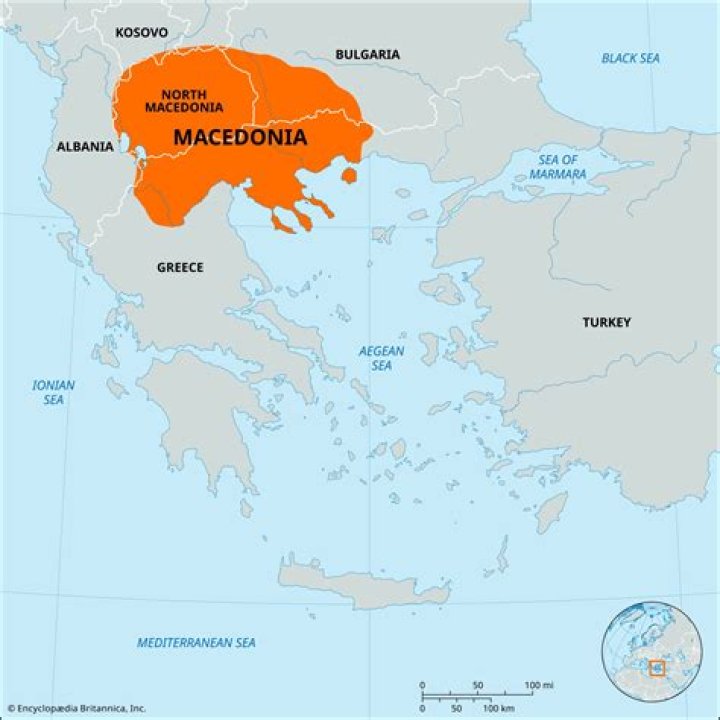
Macedonia has a long, rich history dating back to biblical times. In fact, Macedonia is mentioned at least 23 times in seven books of the Holy Bible. The Macedonian region, located in south-central Balkans, is comprised of northern Greece, southwestern Bulgaria, and the independent Republic of North Macedonia.

Was Macedonia once part of Greece?

listen)) is a geographic and former administrative region of Greece, in the southern Balkans. … Before the expansion of Macedonia under Philip in the 4th century BC, the kingdom of the Macedonians covered an area corresponding roughly to the administrative regions of Western and Central Macedonia in modern Greece.

Was Macedonia part of Persia?

Macedon becomes a fully subordinate part of Persia. Macedon gains independence from Persia. Achaemenid Macedonia refers to the period in which the Kingdom of Macedonia was under the sway of the Achaemenid Persians.

Is Macedonia Greek or Bulgarian?

Macedonia, Macedonian Makedonija, Modern Greek Makedhonía, Bulgarian Makedoniya, region in the south-central Balkans that comprises north-central Greece, southwestern Bulgaria, and the independent Republic of North Macedonia.

Is Macedonia Middle Eastern?

Where is North Macedonia? North Macedonia is geographically located in the Balkan Peninsula in Southeast Europe. Even though it is a small landlocked country, it borders five neighboring countries. These are Kosovo and Serbia on the north, Bulgaria on the east, Greece on the south, and Albania on the west.

Is Macedonia Greek or Roman?

Macedonia (Greek: Μακεδονία) was a province of the Roman Empire, encompassing the territory of the former Antigonid Kingdom of Macedonia, which had been conquered by Rome in 196 BC at the conclusion of the Third Macedonian War.

Is Macedonian Just Bulgarian?

Most Bulgarian linguists consider the Slavic dialects spoken in the region of Macedonia as a part of the Bulgarian dialect area. … From that, the conclusion is drawn that modern standard Macedonian is not a language separate from Bulgarian either but just another written “norm” based on a set of Bulgarian dialects.

What language do they speak in Macedonia?

Macedonian Albanian North Macedonia/Official languages

Were the Romans in Greece?

The definitive Roman occupation of the Greek world was established after the Battle of Actium (31 BC), in which Augustus defeated Cleopatra VII, the Greek Ptolemaic queen of Egypt, and the Roman general Mark Antony, and afterwards conquered Alexandria (30 BC), the last great city of Hellenistic Greece.

Were Spartans Roman or Greek?

The History of Sparta describes the history of the ancient Doric Greek city-state known as Sparta from its beginning in the legendary period to its incorporation into the Achaean League under the late Roman Republic, as Allied State, in 146 BC, a period of roughly 1000 years.

Is Greek older than Roman?

Ancient history includes the recorded Greek history beginning in about 776 BCE (First Olympiad). This coincides roughly with the traditional date of the founding of Rome in 753 BCE and the beginning of the history of Rome.

What color were ancient Romans?

No, the ancient greeks and romans were not “black” in the modern sense of the word. They were white.

Was Egypt part of the Roman Empire?

Egypt became part of the East Roman Empire (Byzantine Empire), which was now a Christian empire.

Did Greece copy Rome?

To clear up a misconception, the Romans did not start copying Greek civilization after they conquered Greece. And it wasn’t Greece specifically that they were copying but Hellenic culture in general, which spanned the Eastern Mediterranean (even Persia at the time Rome first emerged).

Did Romans have blonde hair?

No. They were predominantly brown haired. Blond hair was very fashionable though – Roman ladies would have wigs made from the hair of their German slave women.

Are Italians descendants of Romans?

Yes! Modern Italians are decended from the Ancient Romans. From the founding if Rome in 753 BC by Romulus and Remus to the days of the Roman Kingdom/Empire. Ancient Rome started in Italy.

What color was Romans hair?

blond The most popular hair coloring in ancient Rome was blond, which was associated with the exotic and foreign appearance of people from Gaul, present-day France, and Germany. Roman prostitutes were required by law to dye their hair blond in order to set themselves apart, but many Roman women and men followed suit.

What ethnicity were Spartans?

Greek The Spartans were a minority of the Lakonian population. The largest class of inhabitants were the helots (in Classical Greek Εἵλωτες / Heílôtes). The helots were originally free Greeks from the areas of Messenia and Lakonia whom the Spartans had defeated in battle and subsequently enslaved.

Where did blue eyes come from?

“The mutations responsible for blue eye colour most likely originate from the north-west part of the Black Sea region, where the great agricultural migration of the northern part of Europe took place in the Neolithic periods about 6,000 to 10,000 years ago,” the researchers report in the journal Human Genetics.